



The Hidden Risks of Platform Modernisation: Greenfield vs Brownfield Explained
Modernising enterprise platforms is no longer optional, but choosing between a Greenfield and Brownfield approach carries significant risk if undertaken without strategy, alignment, and capability. This article explores the trade-offs, common failure patterns, and key considerations businesses must evaluate in order to make the right long-term decision.
Why innovation requires a tailored approach
Modernising a business-critical enterprise platform is rarely a simple technical upgrade. Deciding between different modernisation approaches is often muddied by a complex mix of legacy constraints, organisational capabilities, regulatory pressures, data maturity, and long-term business ambition. No matter how you approach it, there’s never a one-sized-fits-all solution. Each organisation must tailor its strategy to its own situation, risk appetite, and operational reality. Get this decision wrong, and the consequences can extend well beyond missed deadlines or budget overruns. Failed platform transformations can stall growth, disrupt your operation, and, in many cases, become career-defining moments for the leaders responsible – and not in a good way.
Until recently the topic of modernising enterprise platforms was primarily a strategic technical decision, now business strategy and objectives play a crucial role in deciding which modernization strategy to choose. But with the breakneck speed that technology is moving, it’s grown into a business-wide necessity. With the global market for modernisation services expected to grow from $19.82 billion USD in 2024 to $39.62 billion USD by 2029, it’s clear where many companies are focussing their efforts and resources. If your business isn’t investing in innovating now, the risk of missing out on the next phase of growth and falling behind your competitors is a very real threat.
Greenfield vs. Brownfield
But identifying the need to modernise is just the tip of the iceberg. Whether you’re being driven to meet customer expectations, keep pace with your competitors, or reduce costs, the far more pressing – and complicated – question is the same, regardless of your motivation: what’s the best way to approach platform modernisation?
Typically, the best approach can be narrowed down to two distinct methodologies: Greenfield vs. Brownfield platform modernisation. Put simply, it’s a choice between starting from scratch or modernising what already exists. Borrowed from land development, the analogy is straightforward: rebuild entirely or renovate.
Maybe one of these approaches jumps out at you as being instantly appealing. There’s certainly no right or wrong answer as it’s largely down to the specific business requirements you need to meet your next phase of growth. With that being said, both Greenfield and Brownfield platform modernisation have benefits and drawbacks that shouldn’t be ignored.
Greenfield
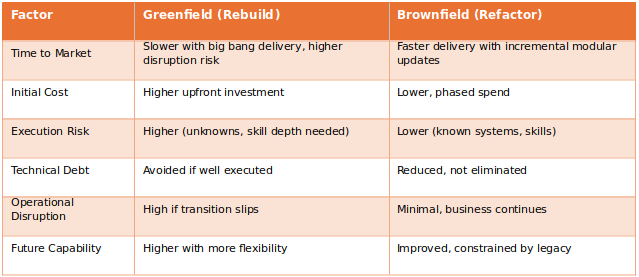
A Greenfield approach is like starting a housing project with a fresh, empty plot of land. It’s daunting and potentially overwhelming, but the opportunities are near endless. You’re faced with full design freedom, enabling innovation, new services and market opportunities but, naturally, require more resources, time and planning.
You’ll face no restrictions and are free to use state-of-the-art tech and innovate without any repercussions. You’re starting from scratch, so you won’t be inheriting as much (or any) technical debt or legacy constraints and can afford to future-proof everything you build, both for scalability and security purposes. For those working with large quantities of legacy debt and a generous budget for innovation, a Greenfield rebuild can be an attractive solution.
But, as with any fresh start, time and money are going to present far greater barriers than they would if you were starting with a pre-existing foundation. And, to compound these higher initial costs and longer development cycles, you’re also opening yourself up to far greater risk and uncertainty without proven systems. A final consideration is the talent and planning that goes into starting a project from scratch. Without a solid platform modernisation strategy and a proven team of experts to execute your vision – much like building without blueprints and relying on an inexperienced team – you’re likely to end up with something far inferior to what you started with.
Brownfield
With Brownfield on the other hand, you’re improving your existing legacy codebase without changing its core functionality. This means retaining the original system and UX while enhancing performance, security, structure and maintainability.
If you’re starting with an established codebase, the instant benefit is a lower upfront cost and a significantly shorter time to deploy new features. Crucially, you’re also building on tried and tested software – proven systems that your users know and understand. You’re free to take advantage of existing business logic and data, taking a lot of guesswork out of the innovation process. This even extends to the look and feel of your product – there’s no expectancy for your users to refamiliarise themselves with a whole new platform.
Let’s think of it in the context of a home renovation again: with a Brownfield approach you’re fixing one room at a time, containing the building site to one quarantined area and leaving the rest of the home in a liveable condition. The disruption to your users will be less intrusive, letting you continue with business as usual. Generally, this solution is optimal for businesses who need a low-risk solution to get them to market quickly, while spending far less than they would on a full Greenfield rebuild.
However, much like renovating an old building, opting for a Brownfield development project leaves you restricted to the confines of what was there before. Your legacy systems could severely hamstring your innovation thanks to unresolved technical debt or complex integration processes. Can you be certain that everything will harmonise and work seamlessly if you’re building off an older system?
The risks of choosing wrong
However you decide to weigh up your options, it’s crucial that you acquire a full picture of both the benefits and consequences of your actions before making a decision. The consequences of choosing the wrong platform modernisation strategy can be nothing short of catastrophic for a business looking to evolve rapidly.
Common failure patterns for both Greenfield and Brownfield platform modernisation arise from their respective shortcomings, but can have equally devastating effects, namely significant delivery slowdowns, or even a complete inability to launch new products.
With Greenfield software development, issues arise from a failure to fully replace the legacy platform you’re looking to escape from. The truth of the matter is that code does not exist in a vacuum, and it’s unlikely that even the most ambitious Greenfield projects can operate independently from all existing stacks. Somewhere along the line, a new product will need to be connecting to existing software (billing or authentication systems, for example), and the risk of carrying over legacy issues will persist. If you are in the advantageous position to take the full time and effort to rewrite everything as part of a Greenfield rebuild, you’re still taking a risk. An extreme example is the disastrous story of Sonos, who took years to rewrite its mobile app, only to break longstanding functionality with its hardware and cloud services, leaving the business stuck with a broken replacement. Sometimes the grass isn’t always greener on the other side.
Brownfield modernisation typically attracts businesses looking to scale fast, putting industries where speed is crucial at a particularly high risk. In these industries there’s a tendency to cut corners in attempting to get a product to market as fast as possible, resulting in transferring legacy issues directly into a new system, making a new platform just as maintenance-heavy and technically debt-laden as its predecessor.
Factors to consider when choosing Greenfield vs Brownfield strategy:
What’s right for you?
To get you thinking about what’s best for your business, there are a few key considerations that anyone choosing between a Greenfield and Brownfield platform modernisation project should understand.
Team Capability
Arguably the most important factor (beside perhaps budget), is the team that you need to execute any sort of platform modernisation strategy. Enterprise industries that typically face issues with a shortage of in-house technical expertise will need to be especially cautious. If you’re reliant on traditional practices, you need to consider the level of expertise that is required to effectively execute any level of legacy platform modernisation. A Greenfield approach requires more skill, but even a ‘simpler’ Brownfield project can end in disaster without the right talent behind it. Regardless of which path you choose, a significant ramp in resources will likely be necessary, and even the most talent rich teams may require the assistance of an outsourcing partner.
Data Complexity
How complicated and widespread is the data you’re working with? This can create issues with both approaches. More complicated data sets raise considerations of legacy issues with a Brownfield development project, while migrating such high volumes of data to a Greenfield project can be equally challenging. It’s key to map complex data structures and dependencies to ensure quality, security, access, governance, and compliance when modernising.
Internal Alignment
As with any other project with such a significant scope, aligning your stakeholders before embarking on a Greenfield or Brownfield platform modernisation project is crucial. A lack of coordinated stakeholder governance can lead to conflicting priorities, scope creep and unresolved dependencies between teams. Exercises such as MoSCoW prioritisation can be crucial in making sure that everyone is aligned. Without a confident project leader and a fully aligned senior leadership team, it won’t matter if you choose a Greenfield or Brownfield approach: it’s almost certain to go poorly.
An outside perspective
Everyone needs all the information available to them to make an informed decision. But equally, having so many pros and cons can be overwhelming, especially when the decision is business critical. Here are some final questions to get you thinking about the approach that’s best for your business:
- What’s your time to market? If you need to move fast, then a full Greenfield rebuild isn’t going to be for you. But remember, however fast you need to move, a rushed job is likely to leave you in a worse position.
- What’s your appetite for risk? If you don’t stand to benefit from the latest tech, then keep things simple and don’t take any unnecessary risk with the most cutting-edge solutions. Sometimes, simple is better.
- What do your internal capabilities look like? Identifying the best approach for your business is only one part of the puzzle: you need to be able to pull it off, too. Don’t discount the possibility of working with an outsourcer.
- What does your industry require? Do you need to move at pace to keep up with your competitors, or can you afford to focus on incremental updates? It’s important to contextualise your business within your sector.
If these questions are raising more questions than answers, it can help to seek the advice of a third-party – somebody to take a comprehensive, unbiased look at your business and help guide you away from the common pitfalls of each approach and toward the solution that stands to benefit you the most.
Engineering Insights can be that strategic technology advisor to help you weigh up the pros and cons of Greenfield vs. Brownfield platform modernisation and make an informed decision that’s right for your business. We place a real emphasis on excellence, which is why our team is led by senior engineers with 10+ years of experience, giving your business the tangible benefit of decades of expertise.
Choosing between Greenfield and Brownfield could define your next five years of growth. You don’t have to make the decision alone. If you’re interested in learning more, you can download our full white paper ‘Legacy Platform Modernisation’ here. Whether you’ve just started exploring modernisation options or are preparing to kick off your project, this white paper gives you practical insight into the options, risks, and opportunities, helping you make informed, board-level decisions with confidence.
If you’re ready to speak with one of our experts and get your modernisation moving, you can book a consultation appointment here.
Close